
Some places expand us, some soothe us, and some seem to ask more from us the moment we arrive. In astrocartography, the planetary lines most often described as “difficult” are not necessarily places I would tell someone to avoid.
- Saturn can build mastery.
- Pluto can transform a life.
- Mars can create momentum.
- Neptune can open a spiritual or creative doorway.
- Uranus can free you from a version of yourself you have outgrown.
But there is an important distinction between a location that changes you and a location that feels sustainable as your everyday home.
When I evaluate a place, I never stop at the planet printed beside a line on the map. I want to know which angle is involved, how that planet functions in the natal chart, what changes in the relocated chart, whether important parans are active, and—most importantly—what you want from the location.
With that in mind, these are five planetary lines I would examine carefully before choosing a place to live long-term.
1. Saturn Lines — The Weight of Building Something Real

Saturn rarely offers the effortless version of a place. Its territory is responsibility, discipline, limits, maturity and time.
Under a strong Saturn line, life may become more serious. Responsibilities can increase. Progress may feel slower. You may find yourself working harder for results that seem to come easily elsewhere. There can also be periods of isolation or a sense that you have to rely more heavily on yourself.
And yet, Saturn is not simply a planet of denial. It is also the planet of structure. A Saturn location can be extraordinarily productive when you are building expertise, authority, a business, a career or a life that needs stronger foundations.
The angle changes the story. Saturn on the Midheaven may emphasize professional responsibility and slow-earned authority. Saturn on the IC can bring seriousness into home, family and foundations. On the Ascendant, Saturn may be experienced more personally; on the Descendant, its lessons can arrive through commitment, boundaries and relationships.
The deeper question Are you in a chapter where you want to build—or are you looking for ease? |
→ New to the map? Read “Planetary Lines Explained in Astrocartography” to understand how each planet expresses through the four angles.
2. Pluto Lines — Transformation You Cannot Keep at the Surface

Pluto locations are rarely superficial. They can bring us into contact with power, psychological depth, endings, regeneration and parts of ourselves that were easier to ignore somewhere else.
Living near a Pluto line can coincide with profound changes in identity, relationships, career direction or the structures that once made life feel predictable. Power dynamics may become more visible. Old patterns can intensify until they are impossible to overlook.
This is why I would not automatically label Pluto “bad.” A Pluto place may become one of the most consequential locations of your life. But transformation and comfort are not the same experience.
If you are intentionally entering a chapter of deep reinvention, Pluto may have something important to offer. If you are choosing a location because you want peace, stability and simplicity, I would look much more carefully at the complete relocation picture.
Some places do not simply give you a new address. They introduce you to a different version of yourself. |
→ Before judging a location from one planetary line, read “How to Read Your Astrocartography Map.”
3. Mars Lines — When Life Turns Up the Volume

Mars brings action, courage, assertion, competition and desire. On a Mars line, you may feel more motivated to move, launch, lead, train or finally act on something you have been postponing. This may be exactly what you need, but Mars energy needs direction. Without a constructive outlet, the same activation can show up as impatience, friction, reactivity or the feeling that life never quite turns the volume down.
Again, the angle matters. Mars on the Midheaven can emphasize ambition and professional drive; Mars on the IC brings that heat into home and private life. Mars on the Ascendant can make the energy highly personal and visible, while Mars on the Descendant may bring it through other people and relationships.
I would not dismiss a Mars location when someone wants momentum, independence or courage. But if the goal is a peaceful retirement, emotional softness or a slower pace, Mars deserves a closer look.
→ Wondering how close you need to be to a line? Read your guide on “How far astrocartography lines can be felt”.
4. Neptune Lines — When the Dream Becomes Louder Than the Details

Neptune is the reason a location can feel enchanted before you can explain why. Its symbolism includes spirituality, intuition, imagination, compassion, creativity and the dissolving of ordinary boundaries. A Neptune place can be deeply meaningful for artists, spiritual seekers and anyone craving a softer connection to life.
But the same quality that makes Neptune beautiful can make practical reality harder to see clearly. Idealization, vague expectations, porous boundaries or confusion can become part of the experience. A destination can feel like your dream while you are visiting and feel very different when you are dealing with contracts, work, money, relationships and ordinary routines.
That does not make Neptune a line I would automatically avoid. It makes Neptune a line I would verify.
Do not destroy the dream. Test it against the rest of the chart. |
→ Read “Best Planetary Lines for Spiritual Growth” for the more supportive side of Neptune and other spiritually significant locations.
5. Uranus Lines — Freedom Has a Price: Predictability
Uranus is awakening, disruption, innovation, independence and the refusal to remain inside a life that no longer fits. A Uranus location can be exhilarating. You may meet unconventional people, change careers, alter your lifestyle or discover a version of yourself that could not fully emerge where you lived before.
But Uranus is not particularly invested in keeping your plans intact. Priorities can change quickly. Relationships or living arrangements may take unexpected turns. What initially feels unstable may ultimately be liberating—but liberation and security are not always asking for the same thing.
If you are ready to reinvent yourself, Uranus can be extraordinary. If you are looking for predictability, roots and a life that stays neatly inside the plan, it may feel exhausting.
→ Learn why the same planet can feel completely different depending on whether it falls on your ASC, DSC, MC or IC. Read “The Complete Guide to Astrocartography“.
The Part Most People Miss: The Line Is Only the Beginning
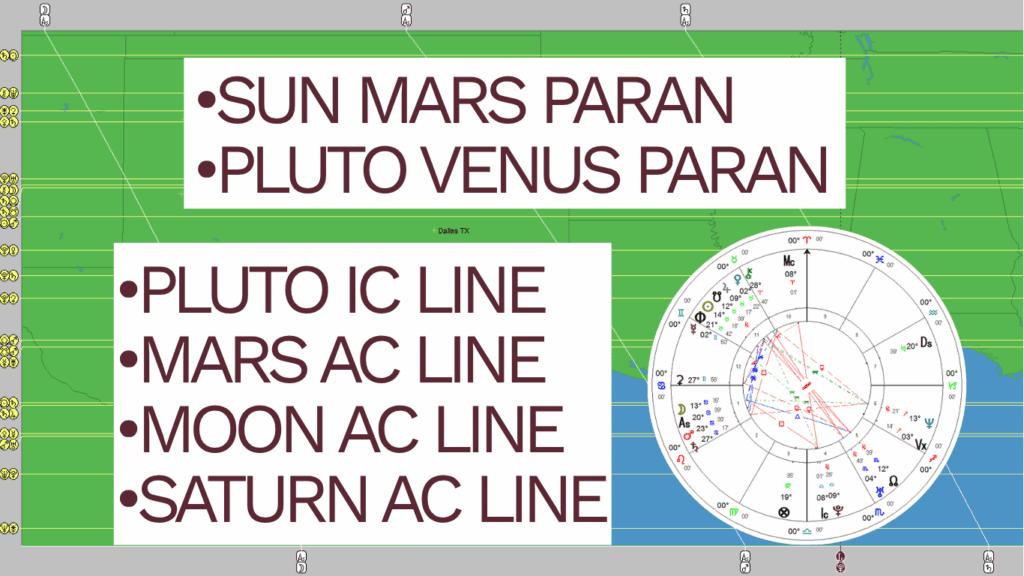
A list of “hardest lines” is useful only if it leads you deeper into the map.
The same Saturn line will not manifest identically for everyone. Neither will Pluto, Mars, Neptune or Uranus. Astrocartography is more specific than planet = good or planet = bad.
BEFORE DECIDING WHETHER A PLACE IS DIFFICULT, CHECK
- The angle: ASC, DSC, MC or IC tells you where the planet is being emphasized.
- The natal planet: its condition and relationships in the birth chart matter.
- The relocated chart: moving changes the angles and houses, adding another layer to the location.
- Nearby parans and other location factors: one line may not be acting alone.
- Your goal: career building, partnership, family, retirement, spiritual growth and reinvention require different environments.
→ Read “What Is a Relocated Chart?” and “What Is a Paran in Astrocartography?” to go beyond the line itself.
So, Should You Avoid the Hardest Planetary Lines?
Not automatically. The lines that challenge us can also be the places where we become more disciplined, courageous, honest, creative or free. But growth and compatibility are not the same thing. A location can change your life without being where you are meant to stay forever. That is why I look beyond the obvious line on the map. Your natal chart, relocated chart, angles and surrounding influences tell a richer story about how a place may actually feel to live in.
| Your map already knows — let’s decode it. Find your aligned place to live, work and thrive with an Astrocartography Reading. |


